Black Peaks, Maybe? A Counterintuitive Nature of Black Peaks

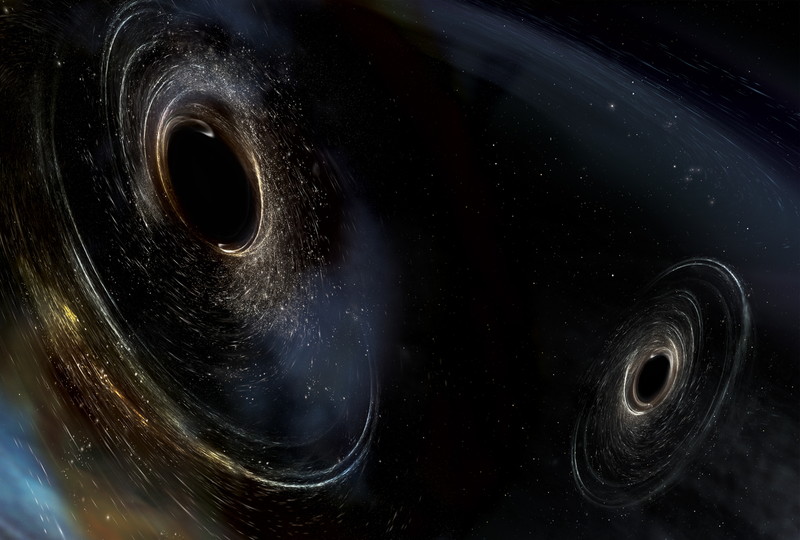
The traditional concept of white holes as the opposite of black holes imagines them as cosmic entities spewing matter and light outward. But what if that interpretation is flawed? What if, instead of an explosive counterpart, the true opposite of a black hole is not a "white hole" but something entirely counterintuitive—a Black Peak?
Black Peaks: Repelling Light and Space
Imagine two bedsheets streched in their own two dimensional planes, where the are facing opposite sides. Now Imagine, a cannon ball dropping on one of the sides of these two adjacent fabrics, it will create a three dimensional hole in the sheet it dropped in, while creating a three dimensional peak in the adjacent sheet on the opposite side. Think of our universe having an adjacent neighbor, another three dimensional universe, just like the adjacent two dimensional sheet. A black hole pulls this fabric inward, creating a steep well—a point of no return where light and matter are trapped by gravity. Now imagine a different phenomenon: instead of bending spacetime inward, the fabric forms an upward peak in the adjacent universe. These Black Peaks will not attract light and matter but rather, repel them.
These steep dark of peaks will have an event horizon of their own, an event horizon that acts as a boundary that prevents anything from approaching too closely. Just as it gets easier for objects to get closer to a black hole, and harder to escape from it, these black peaks will act oppositely, getting closer to them will grow in difficulty until the point where all things are repelled is reached, the Black Peak Event Horizon. This anti-gravity property makes it progressively harder for objects to draw near, with the steepness of spacetime increasing until it becomes insurmountable.
Anti-Time, Anti-Mass, and Zero-Space
Black holes slow time to the point of cessation as one approaches their singularity. Similarly, these Black Peaks may cause space to compress toward zero near their event horizon. What would that mean, it means one might not notice it and go as if it is normal, if the energy to do so was achieved. But for an observer from the outside, the person will be going a great amount of distance. The person might feel like going three miles, lets say, per the measurement device he is holding, but for an outside observer, that distance will be a much greater distance. So, stars that are not as far, might as a result, appear to be much farther when their light passes around these black peaks.
Within this framework, Black Peaks would not only repel light but embody an "anti-mass" property, pushing against the gravitational norms we associate with cosmic structures. Their interaction with time might also be inverse, where rather than stretching or stopping time, they might distort it in ways we have yet to comprehend. And if time is going to be an anti-time past the event horizon of a black hole, space might also be an anti-space beyond the event horizons of these hypothetical black peaks.
A Redefinition of Opposites
Rather than spewing energy outward as white holes are traditionally theorized to do, these Black Peaks might represent cosmic structures that bounce light away from their event horizons, or bend them in a way that makes the light appear to be much further away. This would explain their extreme darkness—darker even than black holes it would be difficult for object to even reach their event horizon. This deflection of light might result in a space that behaves like an anti-black hole in every sense:
- Black Hole: Light/matter fall inward, progressively accelerating.
- Black Peak: Light/matter are repelled outward, facing increasing resistance the closer they attempt to approach.
The Role of Black Peaks in Dark Matter
Could Black Peaks be the answer to one of the most perplexing mysteries in modern astrophysics—dark matter? If dark matter is the invisible scaffolding upon which galaxies are built, its properties are far from ordinary. It neither emits nor absorbs light, yet it exerts gravitational influence on visible matter, bending light and holding galaxies together. However, what if our understanding of dark matter's nature has been fundamentally incomplete?
Black Peaks as Dark Matter: A Cosmic Duality
The notion of Black Peaks reimagines dark matter not as a mysterious particle but as a cosmic phenomenon intrinsically tied to the structure of the universe. Unlike black holes, which pull matter and energy inward, Black Peaks repel. They push against spacetime, creating regions of concentrated anti-gravity that manifest as an unseen, expansive force. These peaks could be scattered across the cosmos, their repelling nature exerting the exact kind of gravitational influence attributed to dark matter.
If Black Peaks are indeed what we call dark matter, this would explain several observed phenomena:
- Gravitational Lensing Without Visible Mass: In regions where dark matter is inferred through gravitational lensing, Black Peaks could be the culprits. Their repelling nature would distort spacetime in ways that cause light to bend, similar to the gravitational pull of massive objects, but without the corresponding visible matter.
- Galaxy Formation and Stability: Dark matter is essential for explaining why galaxies hold together despite the centrifugal forces of their rotation. Black Peaks, with their anti-gravity properties, could create a counterbalance to black holes, stabilizing the galaxy's structure and preventing it from flying apart.
- The Cosmic Web: Dark matter is thought to form a vast, interconnected web of filaments linking galaxies and clusters. Black Peaks, as sources of anti-gravity, could provide the repelling forces necessary to shape and maintain this large-scale structure. Maybe all that we can see exists by the side of the trough of a universe filled with peaks we can't explore.
Anti-Mass and the Push Against Spacetime
If black holes are sources of extreme gravitational attraction due to their immense density, Black Peaks might represent the inverse—sources of anti-mass that stretch spacetime outward. This anti-mass property could explain dark matter's apparent resistance to clumping or forming dense structures. Unlike regular matter, which collapses under gravity to form stars and planets, Black Peaks would repel both themselves and ordinary matter, spreading their influence over vast distances. But saying this, I am not certain of what the relationship between black hole and a black peak might be, would they cancel out each other, or would they form a black hole - black peak combination that is even more strange?
Another intriguing possibility is that Black Peaks, like black holes, could interact with the fabric of time itself. While time slows to a near-halt at the edge of a black hole, Black Peaks might distort time in an opposing fashion, creating zones of accelerated temporal flow. This temporal interaction could explain why dark matter interacts gravitationally but not electromagnetically—it might exist in a state where traditional notions of time and energy exchange no longer apply.
Stabilizing the Universe's Large-Scale Structure
In this framework, Black Peaks and black holes form a cosmic duality that governs the large-scale structure of the universe. Black holes attract matter and energy, anchoring galaxies and driving their evolution. Black Peaks, meanwhile, repel and expand, countering the pull of black holes and preventing runaway gravitational collapse. And, it might not even need be another adjacent universe, it all might even be possible in the same universe, for both the inside and the underside to exist.
This duality could also explain why the universe's expansion is accelerating. If Black Peaks are distributed throughout the cosmos, their anti-gravity influence might act as a counterforce to gravity, contributing to the mysterious phenomenon of dark energy as well.