Are We the Fancier Chimps of This Earth? The Possibility of Homo Sapiens Being Under The Homo Thalassa

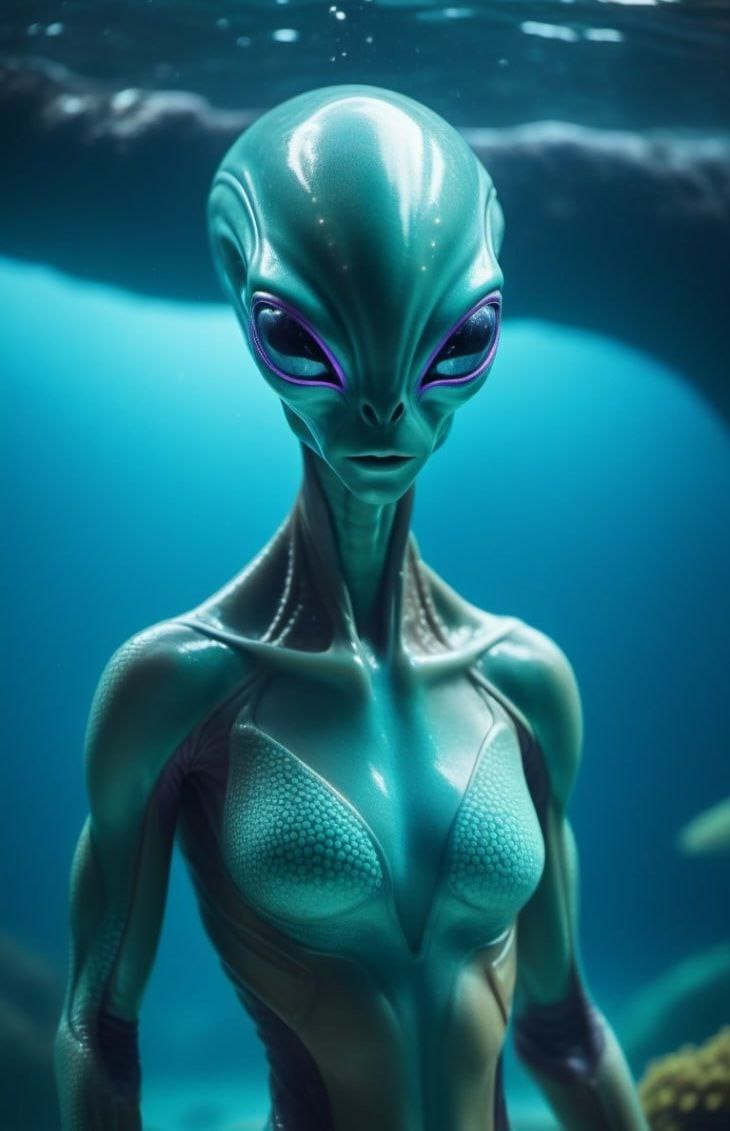
Have you ever wondered if we, as humans, might not be the most advanced species on Earth? What if we are to another species of this planet what chimps are to us—intelligent and remarkable in our own right, but just a step behind in a much larger evolutionary picture? What if the beings we’ve been calling aliens—the mysterious entities reported in UFO sightings—are not extraterrestrials at all, but a long-hidden, more intelligent species from the depths of our oceans? This idea opens up a new dimension to our understanding of both our place on Earth and the strange anomalies in our history. It might also explain why human depictions of aliens after encounters often resemble creatures with anthropomorphic features.
Not everyone might embrace such a notion, and that’s completely understandable. If this were true, it would likely be kept hidden, as parts of society, particularly those invested in the belief that humanity is the pinnacle of creation, might struggle to accept it. Perhaps as intelligence advances, inter-species interaction takes forms we cannot yet comprehend. On a planet that is 70% water, could it be that Westworld is our reality, and a species that evolved independently of us—much like chimps and bonobos—exists, hidden beneath the waves? A species to which we may have some physical advantages, but that surpasses us in intelligence, making them the true dominant force on this planet. And, using the Greek word for sea, let's indulge in this hypothesis and name them the Homo Thalassa.
The Fancier Chimps of Earth: Homo sapiens Under Homo Thalassa
Imagine for a moment that we, Homo sapiens, are not the pinnacle of evolution but instead the silver medalists of this planet. This notion might seem audacious at first, but consider the possibility: just as humans observe and interact with chimpanzees—studying them, influencing their environment, or tagging them to track their behavior—there could be a species far more advanced than us, silently observing from the depths of Earth’s oceans, emerging only when necessary. Perhaps they take a few of us for study, tag some to follow their movements, or even watch us with curiosity, much like we do when visiting a zoo. And just as our lives remain elusive to the animals around us, their existence would be equally imperceptible to us.
Could this also explain why they might allow human cruelty to persist? After all, we often turn a blind eye to animal suffering in the wild, believing it to be part of a natural order. If such beings exist, their detachment from human affairs might stem from a similar perspective.
In this scenario, the species we might call Homo thalassa—the "sea humans"—could be the true intellectual and technological elites of Earth. These beings might be the hidden architects of the grand monuments of ancient civilizations or, at the very least, the source of the unexplained sophistications of our past. Consider the megalithic wonders: the Great Pyramids of Egypt, Machu Picchu, Stonehenge, and countless other ancient marvels. The advanced knowledge required to create such awe-inspiring structures may not have originated from humanity at all but from these oceanic beings, who possessed the wisdom to guide us—without revealing their hand.
Homo thalassa could have been the species that guided our ancestors, providing them with the knowledge to build these monuments and leave behind mysteries we still struggle to solve today. The ancient myths of gods descending from the sea, such as Oannes in Mesopotamian mythology, could be echoes of encounters with these beings. Perhaps they didn’t just shape our history—they may have been the catalysts behind the civilizations that shaped our world.
The Ocean: Earth’s Final Frontier
The ocean is still one of Earth’s greatest mysteries. While we’ve explored space in ways that would have been unimaginable to our ancestors, we’ve barely scratched the surface of what lies beneath the ocean’s depths. Could these aquatic beings live in the deepest parts of the ocean, hidden from human sight, avoiding our attempts at discovery? Or have they retreated, leaving Earth altogether, with only occasional visits to observe us?
The idea that humans may not be the dominant species on Earth is a humbling one. Just as we study chimps and orcas, Homo thalassa might be studying us—watching as we build our cities, wage our wars, and struggle with the complexities of existence. They could be silently observing our development, guiding us when necessary, but remaining hidden from view, just as we are the rest of a significant portion of animals.
Final Thoughts: A Humbling Truth?
If Homo thalassa exists, it would shake the very foundations of what we understand about ourselves. The realization that we are not the ultimate rulers of this planet but rather a species just beginning to grasp its true complexity could transform our perception of everything—from our place in the natural world to our understanding of technology and civilization. Such a revelation could also provide answers to many of our enduring mysteries, from the anthropomorphic features described in alien encounter reports to the enigmas of our past, the patterns of our civilizations, and the countless UFO sightings.
As we continue to explore the depths of the ocean and the vastness of the cosmos, perhaps we are not searching for extraterrestrial life, but for our long-lost cousins beneath the waves. It’s a humbling thought, one that forces us to question: Are we truly at the top of the food chain, or merely a chapter in the ongoing story of Earth’s evolution?